A coolant reservoir that appears full does not prove that an engine's cooling system is working correctly. The fluid must circulate through the right routes, transfer heat effectively and operate with the appropriate pressure and control. A fault in any of those functions can allow the engine to overheat even when the visible level looks normal.
If the temperature warning appears or the gauge moves into an abnormal range, respond to the warning rather than the reassuring sight of fluid in the tank. Stop safely, switch off and follow the handbook. Do not remove the cap while the system is hot: pressurised coolant and steam can cause serious burns.
Why a full tank can still accompany overheating
The reservoir shows only part of the system's condition. It does not tell you whether coolant is circulating through the engine and radiator, whether trapped air is present or whether the radiator receives enough airflow. On some vehicles, different circuits and valves make the relationship between reservoir level and heat transfer more complex.
Check the level only under the conditions specified by the manufacturer, normally with the engine cold where a conventional expansion tank is fitted. A hot reading cannot simply be compared with a cold mark. If the system has recently been opened for a repair, correct filling and bleeding are especially relevant to the investigation.
The pattern of overheating helps guide the checks
Temperature rising in traffic
If the problem appears mainly while stationary or moving slowly, radiator airflow and fan operation are among the areas to assess. Road speed normally provides airflow that is absent in a queue. The fan, its electrical supply and its control strategy may therefore need testing rather than assuming that the radiator itself has failed.
Do not put your hands near a fan to see whether it starts. Some systems can operate unexpectedly, including after the engine has been switched off. A workshop can command or observe operation safely and check whether the response matches the vehicle's requirements.
Temperature rising under sustained demand
Overheating during a longer climb or higher engine demand can point the investigation towards circulation, heat transfer or another underlying engine problem. A restricted radiator, a thermostat fault or inadequate pump operation may be relevant, but the driving pattern cannot confirm any one of them by itself.
Tell the workshop whether cabin heating changes at the same time, whether the warning follows a particular journey and whether any coolant work was carried out recently. These details can help build a test plan. They are not a reason to keep driving until the pattern repeats.
Circulation, thermostat and trapped air
The water pump moves coolant, while thermostats and other controls manage its route according to the design. A problem with pump drive, an internal impeller or electronic control can affect circulation. The presence of a turning pulley does not necessarily prove that the required coolant flow is being achieved.
A thermostat that does not operate correctly can also disturb temperature control. Air left after maintenance may interfere with circulation or sensor readings. Some vehicles require a specific vacuum-filling or electronically controlled bleeding procedure. Simply adding more coolant is not a universal solution and can lead to overfilling.
Could the temperature reading be wrong?
A sensor or wiring fault is possible, but it should not be assumed when an overheating warning appears. The workshop can compare diagnostic temperature information with other appropriate measurements and assess whether the reading is plausible. A warning must be treated seriously until the actual temperature condition is established.
Pressure testing, inspection for leakage and further engine tests may be appropriate if the findings suggest a related fault. A head-gasket diagnosis should be supported by evidence, not inferred solely from a high gauge reading. Equally, the absence of an obvious leak does not rule out an internal or intermittent problem.
What not to do at the roadside
Do not open a hot coolant cap, pour cold water onto the engine or keep topping up without understanding why the warning occurred. Avoid repeatedly restarting an engine that has overheated. A normal-looking gauge after cooling down does not establish that the cause has gone away.
If the car cannot be assessed safely where it is, discuss vehicle recovery. Getting the vehicle to the workshop without further overheating may prevent an initially contained cooling fault from becoming a much larger engine repair.
Diagnosis and repair at Pit-Air Motors
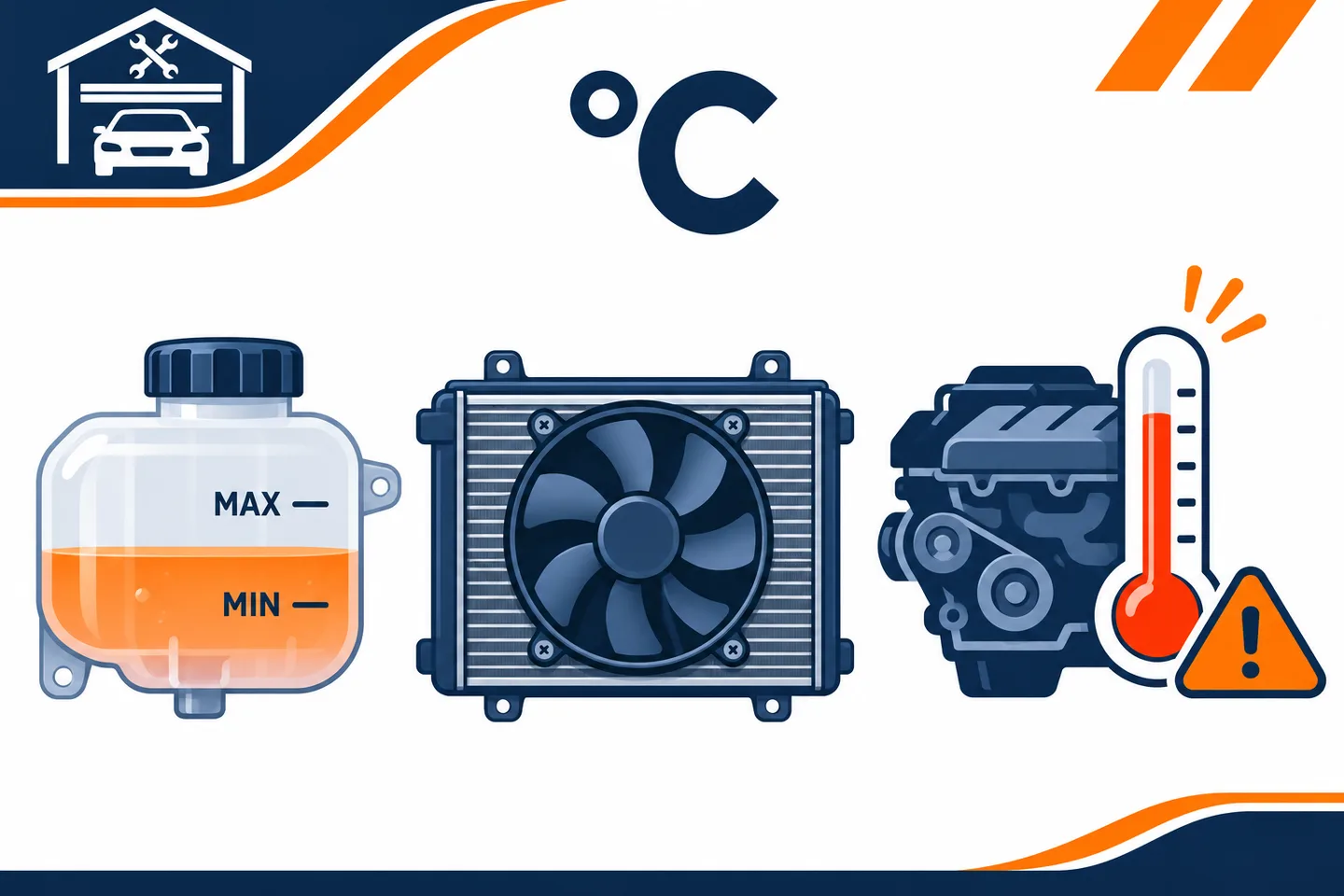
Our engine repair service can assess cooling-related symptoms and agree the appropriate checks. Bring the warning description, recent repair history and details of when the temperature rose. The conceptual illustration shows coolant level, radiator airflow and engine temperature; it is not a vehicle-specific system diagram.
After a repair, the system needs the correct coolant, filling procedure and checks relevant to the fault. Ask how circulation, temperature control and leakage will be assessed before the vehicle is returned. A new component alone is not the whole verification process.
Planning an unexpected cooling repair
Agree the diagnostic stage before authorising wider work, particularly if possible overheating damage needs investigation. If the confirmed bill is difficult to meet at once, enquire through our Car repair finance page. Availability and terms must be confirmed. Continuing to drive an overheating car is not a sensible way to postpone that decision.